The Mystery of Gobekli Tepe

At around 12,500 years ago, human beings started to domesticate plants and animals around the world. This was the start of the geological epoch known as the Holocene. During this time, human beings also started to transition from a hunter-gatherer species to an agricultural-farming one, and thereafter began the great creation of towns and cities and the basis of civilisation. Prior to this ‘Neolithic Revolution’, we were nomadic creatures, with no written language, and with tools and technologies driven largely by our need to hunt on the land and sea and survive the elements day to day.

We need to remember also that 12,500 years ago corresponded to the end of the last ice age, where vast ice sheets had covered much of North America, Northern Europe and Asia, with their maximum extent around 26,500 years ago. The glaciers in the Northern Hemisphere began to retreat around 19,000 years ago. After the end of the last ice age came the period known as the Younger Dryas, which was between 12,900 to 11,700 years ago, which saw a temporary reversal of the gradual climatic warming. This was clearly a dramatic time to be on planet Earth and in particular in the Northern Hemisphere, and it is interesting that the Neolithic Revolution really came at the end of this ice age, permitting the conditions for human beings to thrive, apparently for the first time. Or was it?

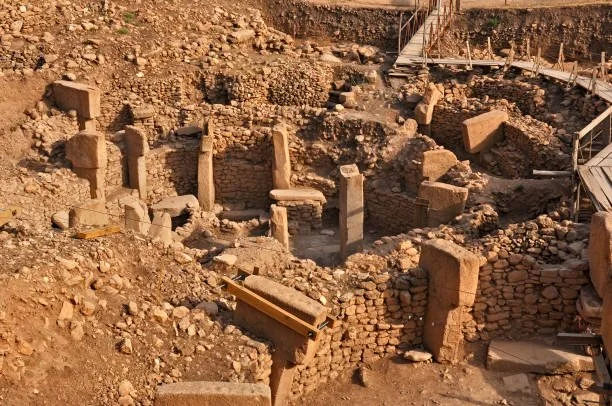
The archaeological site at Gobekli Tepe in Turkey

Between the years 1996 to 2014 a site in Turkey was excavated by a renowned German archeologists called Klaus Schmidt, from the University of Erlangen. The site was in the South Eastern Anatolia region of Turkey and it had the appearance of a hill, and so it was called ‘Potbelly Hill’ which in Turkish is written Gobekli Tepe. The site is around 1,000 ft in diameter and 50 ft high and is located 2,500 ft above sea level. Schmidt and his team were not the original discovers of the site, but it had originally be discovered in 1963 by the American archaeologist Peter Benedict from the University of Chicago in co-operation with Istanbul University.

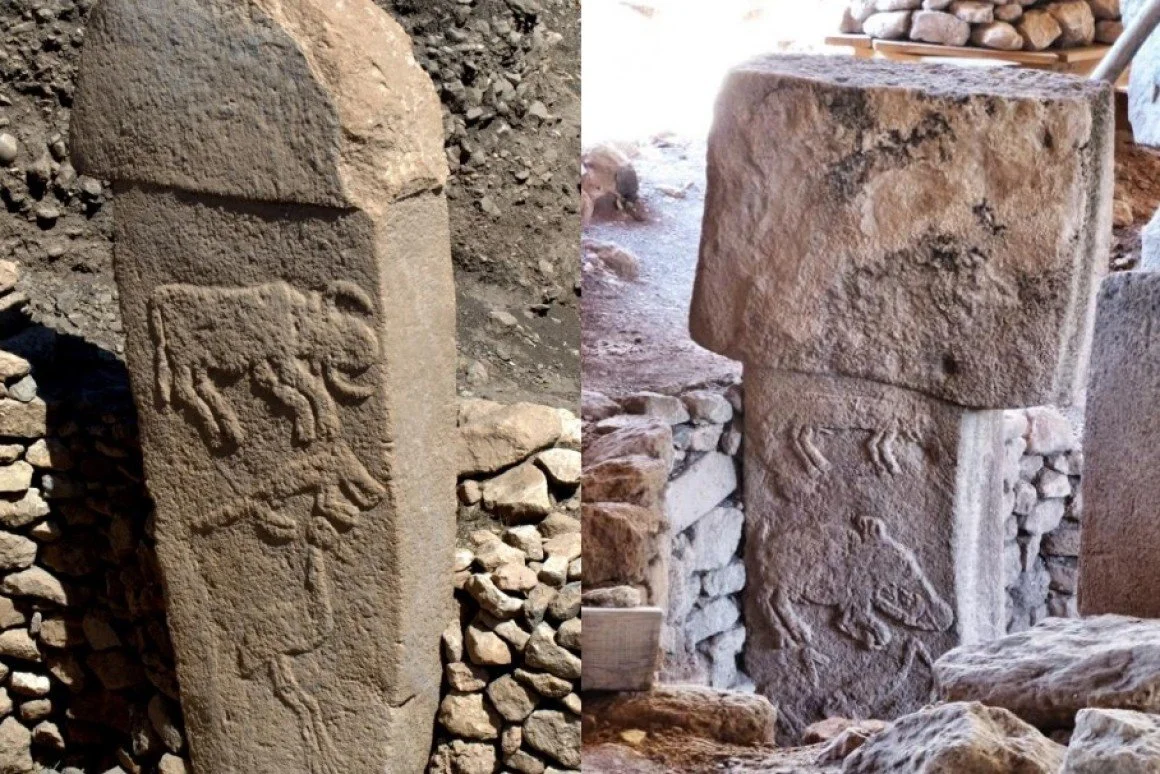
After having spent several years excavating the site, Schmidt uncovered several layers which he had radiocarbon dated to 7,370 - 7,560 years ago (Enclosure C), 7,970 - 8,280 years ago (Enclosure B), 8,620 - 9,110 years ago (Layer III) and 8,800 - 9,2130 years ago (Layer III). The team found an astonishing set of T-shaped pillars forming what appeared to be a Temple or stone circle configuration. Many of the pillars contained pictograms and animal relief carvings, presumably to represent sacred symbols. The animal reliefs included lions, bulls, boars, foxes, gazelles, donkeys, snakes and other reptiles. They even included insects, arachnids and birds. Overall, the site displays the signature of a high culture and with a sophisticated knowledge of architecture and also possibly astronomy, and the use of stone tools - not expected of a hunter gatherer society.

Examples of some of the stone T-shaped pillars at Gobekli Tepe

The discovery of Gobekli Tepi is evidence suggestive of a non-linear history, which departs from so called gradualism. To construct a site like this, and noting that only around 5% of it has been excavated by archeologists to date, does not seem possible with a simple hunter gatherer society. This project would have required perhaps several hundred people working on it for years or decades, and they had to be fed with sufficient resources to not interrupt the construction. Just like the Clovis First model of the America’s, much of our understanding of history appears to be in need of revision. In fact, the site is suggestive that we are living in a post-apocalyptic era, and that there may be some truths to the mythologies of a great flood that swept across the Earth and also that prior to this existed advanced human societies.

The most incredible thing about this site in Turkey, is the view from Schmidt, that the site had been deliberately buried after its use. What could motivate a people to bury such a site? There would appear to be two possible reasons, which is to protect it (or preserve it) or to hide it from discovery by others. But protect it from what? And to hide it from whom? One thing is for sure, the only way we are going to unlock the answers to these questions is by fully committing to a major archaeological excavation program in Turkey. Let us hope that happens soon.

This article was originally posted on a previous web site for the asterism project on 15th Jul 2020 and it has been copied here since that site was closed down.

Worshipping the Sun

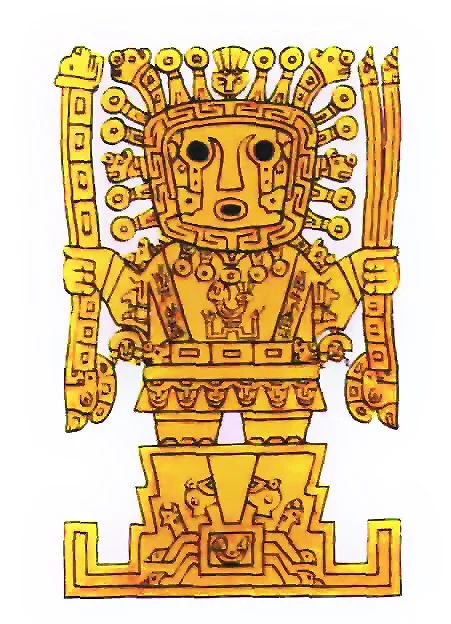
In ancient Egypt people worshipped the Sun God Ra, and he was believed to rule in all parts of the created world including the sky, Earth and the underworld. In ancient Greece people worshipped Helios as a god and personification of the Sun. The ancient Maya worshipped a Sun god called Kinich Ahau. The Inca people of the Andes region of South America worshipped the god Viracocha, who is said to have created the universe, sun, moon and stars. He was said to command the Sun to move over the sky and he was seen as the god of the Sun and storms. Continuing this through mythologies and traditions of ancient people around the world, we could keep listing gods related to the Sun and find a common adoration and gratitude for its presence.

Inca God Viracocha

Why were the ancients so fascinated with the Sun and its positioning in the heavens? They were also interested in other elements of the heavens including the Moon, planets and the stars themselves. In particular, tracking the path of the Earth and its true North axis through the phases of the zodiac seems to have been of great interest.

There are twelve original constellations of the zodiac, which were used by the Egyptians but probably originated in ancient Summeria and are known as the Astrological ages. These occupy 30 degrees of celestial longitude and approximately correspond to the constellations of Aries, Taurus, Gemini, Cancer, Leo, Virgo, Libra, Scorpio, Sagittarius, Capricorn, Aquarius and Pisces. Currently we are in the age of Pisces and are transitioning to the age of Aquarius. Each of the age is characterised by a duration of around 2160 years, and 12 times this gives us a total of 25,920 years, which also is the total duration for the precession of the equinox. Together this celestial coordinate system takes the ecliptic as the origin of latitude and the Sun’s position at vernal equinox as the origin of longitude.

Equinox means equal night. The vernal equinox is the point on the horizon at which the Sun’s path crosses the celestial equator moving from South to North. There are two of these that occur each year and they are known as the first day of spring in the Northern Hemisphere. The Autumn equinox is the date in the year when the Earth experiences a 12 hour day and a 12 hour night and occurs in late September. In addition to the equinox, there is also the solstices. The summer solstice is the date on which the Sun is the highest in the sky at noon in the Northern hemisphere and usually occurs in late June. Tracking these events is very useful for ancient agriculture so that one can plan for crops and is a necessary component of any society that has moved out of a hunter-gatherer status and is seeking to build a civilisation. They are also useful as calendar markers.

Many of the ancient megalithic structures exhibit cardinal alignments which are clearly linked to astronomical phenomena. But the Sun appears to get special interest. At the ancient Stonehenge site in England for example, the stones are carefully aligned so that if one sits at the centre, you have a clear view of the summer solstice sun rising over the heel stone. Similarly, you can see the Sun setting at the winter solstice.

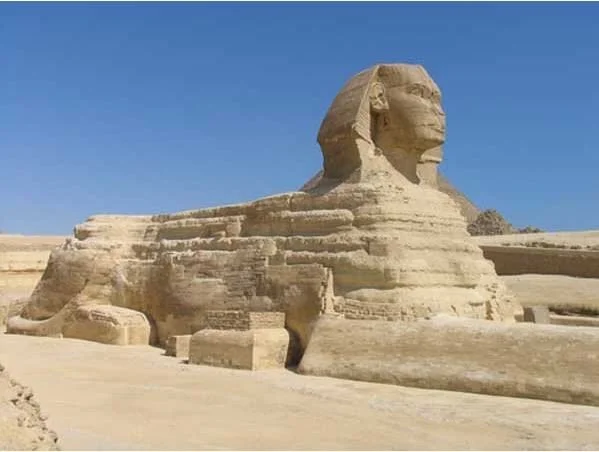
Near the Great Pyramid in Cairo, Egypt, one can stand on the body of the Great Sphinx which has the body of a Lion and the statue lies exactly along the East-West axis of the Giza necropolis, with its gaze looking directly East, so that it stares at the rising Sun during the vernal equinox. At dawn on the vernal equinox one can also gaze directly at the rise of its own celestial counterpart in the constellation of Leo, to create a celestial rising, just as the Sun begins to rise. Although curiously, this only happens around 10,500 years ago, a date which is inconsistent with the claimed archaeological dating of the Sphinx from Egyptologists. Similarly, Serpent Mound in the state of Ohio in America, appears to also gaze directly at the summer solstice at Sunset. Indeed, if we travel around the world and examine many of the ancient megalithic structures, we find profound cardinal alignments which clearly demonstrate that people from all cultures sought out astronomical significance in the construction of their temples and religious sites of interest.

Perhaps its not a surprise, as mentioned there are practical reasons for tracking the movement of the Sun such as for agricultural planning and the correct measurement of the seasons. But also, in addition to air and water, the Sun appears to be the main energy giver for all life on Earth, and so it is not unreasonable for ancient people to associate this object with their divine worship.

Maybe, it was about creating a spiritual moment, where the Earth (the land of people) and the Stars (the land of the Gods) would become joined for just an instant, during one of these equinox or solstice events. That this is where you could experience the divine and actually feel the presence of a creator. Such observations were also usually accompanied by rituals, and it is possible that a society seeing that the elders were able to conjure the exact positioning of the Sun as a part of these rituals, also reinforced a religious belief and so a hierarchical system of control over a population.

Whatever is true, our link to our ancient ancestors is provided by our shared need for the Sun, since without it neither of us would have been here. That object connects us to our past but also our future, as it continues to rise and fall with the setting of the day. If any object ever deserved the honorary title of a God, the Sun is surely it.

This article was originally posted on a previous web site for the asterism project on 15th Jul 2020 and it has been copied here since that site was closed down.

Being Human & the Nature of Homo Sapiens

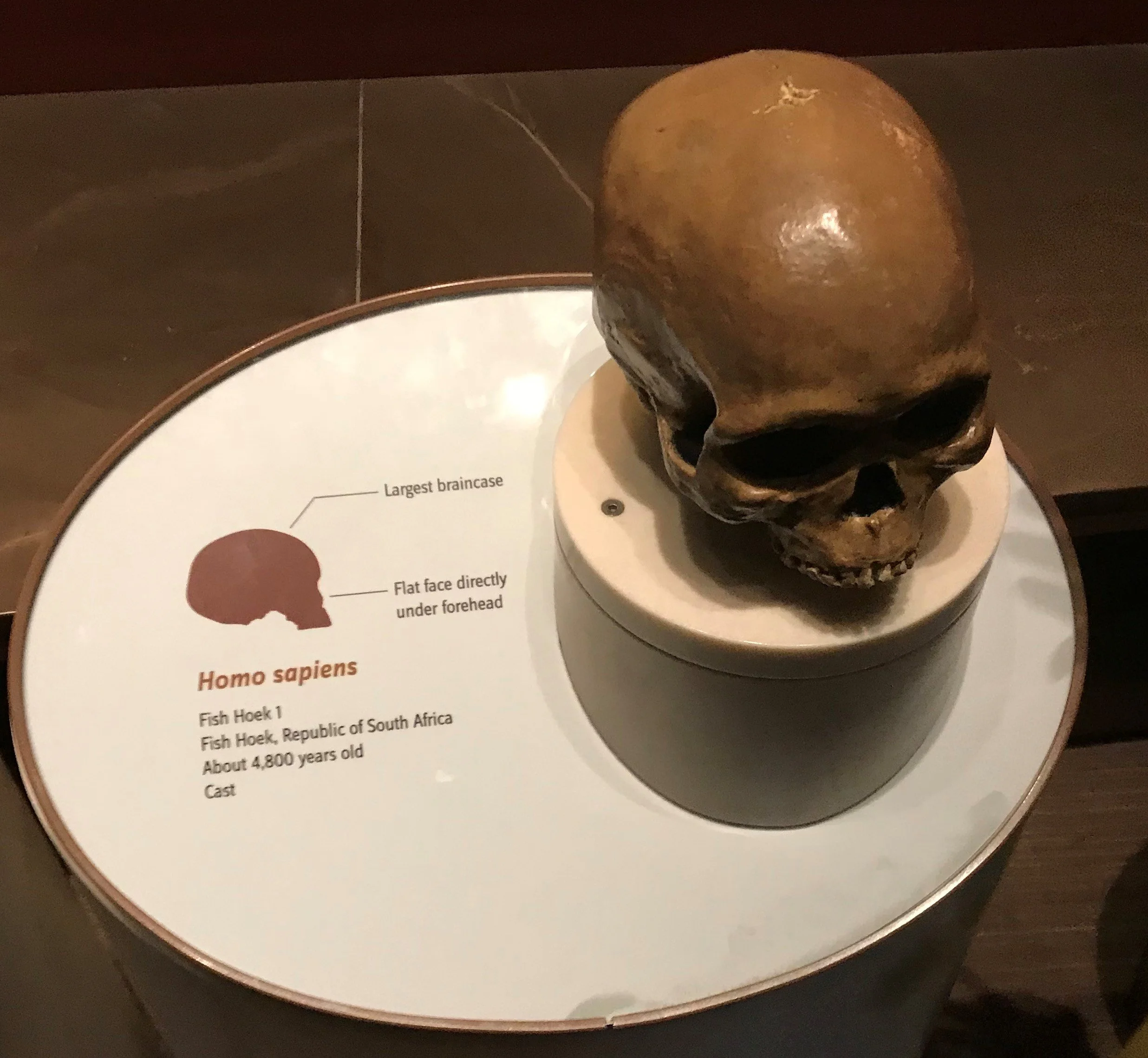
A homo sapien (‘thinking man’) is an extinct species of the genus Homo, which also includes Homo erectus. The genus is believed to have emerged out of Africa from a predecessor species approximately 200,000 to 300,000 years ago. The term Middle Palaeolithic defines the period when Homo sapiens first emerged and the emergence of the full behaviour modernity occurred around 40,000 to 50,000 years ago, in what is known as the Upper Paleolithic. During this period the modern human arose though cognitive and genetic changes.

The behaviour modernity, is a trait that distinguishes current Homo sapiens from other anatomically modern humans, hominins and primates. This is characterised by abstract thinking, planning, exploitation of games, music, dance, art and others. But what does it mean to be a human being?

Anatomically, we have two upper limbs (arms), two lower limbs (legs), hands and fingers, feet and toes, a head and neck, a chest, an intestine and stomach, a spinal cord, certain organs for physical function such as heart, lung, kidneys, liver and more. But clearly this does not define a human being, although it does appear to define our shared genus of hominins.

Our interaction with the physical world around us is provided by our senses. This includes our touch, taste, smell, hearing and vision. All of our connections to the physical world are enabled by these senses, transmitting information down specialised neurons in the skin. Any changes in pressure, temperature, vibration or pain and other sensations are all attributed to the different receptors in the skin, and ultimately this change is communicated to the brain which then measures that change against a model of the world that it has built based on experience.

But what if we were to remove the human body, and just place the human brain in a jar. If sensors were connected to the key parts of the brain so that you could still experience those key senses of touch, taste, sound, hearing and vision, but through computational input that is say on a random number generator to ensure variety of experience, would you know the difference? Would you still feel like you were a human being if those sensory inputs matched exactly your model of the real world? Would you know when you were not?

It would seem that your physical anatomy does not really define who you are. Then if we consider the future possibilities for the evolution of homo sapiens in different environments. Like if we adapt to living more permanently in water or as we explore space and settle other planets with different atmospheres, radiation levels, gravity. Indeed, in a micro-gravity environment where people just float around, what use is there for legs? Would it be more sensible if those legs evolved to become a second set of arms?

Then what defines being human? Is it our cognitive abilities? Is it our artistic and scientific output? Is it our ethics and morals about what is good and bad, right and wrong? Is it in how we treat others and other life-forms? With the advances in medical sciences, it seems that in the future our very anatomical definitions for what is a human being will be difficult to define. With the continued convergence of biology with technology (artificial intelligence) our cognitive and abstract abilities are surely to receive an exponential enhancement from the existing capacity.

As we continue to explore the new domains of exploration and discovery, it is important to move forward with an understanding for what is important to us. What is it that we would like to preserve, and what other things do we not mind if they undergo change? Are we okay if we continue to evolve (naturally or artificially) into something else that is definitely not what we would recognise as human today? Since we are still exploring our ancestral genus and those of other hominins, and we do not yet have a complete picture for how each is related, it is also important that we keep an eye on where we are going and what we will become. Preserving our human nature, may be the biggest challenge that still awaits us, in the climate of a dynamic and evolving universe.

This article was originally posted on a previous web site for the asterism project on 15th Jul 2020 and it has been copied here since that site was closed down.

Inventory Stele and the Sphinx in Egypt

The Great Sphinx of Giza in Cairo, Egypt, is one of the most remarkable sculptors ever devised by human hands. It is claimed by Egyptologists to be dated to the Old Kingdom during the reign of the pharaoh Khafre/Khufu in around 2558 - 2532 BC. But much controversy has arisen over the Sphinx in recent years, with claims that it may be much older than this. In particular, the erosion of the Sphinx enclosure shows evidence of precipitation induced weathering which is caused by significant and prolonged periods of rain fall or flooding. The Boston University geologist Robert Schoch claims that this suggests its age is more like around 10,500 BC, which pre-dates Dynastic Egypt by many thousands of years.

The Great Sphinx in Egypt

Its dating is further complicated by claims that the Sphinx faces exactly due east as a perfect equinoctial marker, where it looks upon the sunrise at dawn. At the same time, it also faces the rising constellation of Leo, but this also occurs around 10,500 BC. None of this is helped by the controversial ‘restoration work’ that is carried out by the local Egyptian authorities amid claims they are trying to cover up evidence that would allow accurate dating of the Sphinx.

However, there is a little bit of history that is not so widely known to the public, and it has been hidden from public display for some years, after initially being exhibited at the Cairo museum, but now appears to have been withdrawn from public display. That is the Inventory Stele. This is a commemorative tablet that apparently dates to the 26th Dynasty which is around 670 BC. It was found in in Giza in 1858 by the French archaeologist Auguste Mariette when he was excavating the Isis Temple which is located on the Giza complex. Although some Egyptologists view the Stele with great caution and is claimed by scholars to be a fake contemporary to its dated age, this is also convenient because the writing on the Stele appears to convey information which contradicts the historical view of Dynastic Egypt.

Inventory Stele of ancient Egypt, which was once displayed in the Cairo Museum.

In fact, although it has largely been dismissed as a fraud, Robert Schoch and its colleague Manu Seyfzadeh have published a paper titled “The Inventory Stele: More Fact than Fiction” (Archaeological Discovery, Vol.6, No.2. pp.103-161, April 2018), in which they conclude “From our analysis we conclude that while we cannot rule out a couple of minor modifications of names from the original written version we date to the 5th Dynasty, there is no plausible reason to dismiss the entire account recorded in this Late Period version on those ground alone and that the events it describes appear more factual than fictitious”. The authors attribute the current dating to misconceptions in part due to errors and oversights contained in two referenced translations. So what does the Inventory Stele actually say? He is a brief extract:

“Long live the King of Upper and Lower Egyupt, khufu, given life....He found the house of Isis, Mistress of the Pyramid, by the side of the hollow of Hwran {The Sphinx} and he built his pyramid beside the temple of this goddess and he built a pyramid for the King’s daughter Henutsen, beside this temple. The place of Hwran Hormakhet is on the South side of the House of Isis, Mistress of the pyramid....He restored the statue, all covered in painting, of the guardian of the atmosphere, who guides the winds with his gaze. He replaced the back part of the Nemes head-dress, which was missing with gilded stone. The figure of this god, cut in stone, is solid and will last to eternity, keeping its face looking always to the East.

These words, imply that the Great Pyramid and the Temple of Isis existed before the time of Khufu (c.2580 BC), and it describes how Khufu came upon the Sphinx, where it was already buried in the sand. Whether one believes this viewpoint or instead the view of main stream Egyptologists, is a matter of personal opinion, and to come to an informed opinion certainly requires substantial study of the artefact, its history and translations. But if the words are to be believed, then this would be proof that Khufu did not build the Great Pyramid or the Sphinx and that they were already on site long before his time. This would then bring the dates of 10,500 BC or 12,500 years ago, into the realm of plausibility. Although there is debate about the dating of the artefact, there is little disagreement about its content, which appears to be genuine. This debate is sure to run on and the accurate dating of the text on the Inventory Stele may be the key to unlocking the true history of what happened on the Giza plateau all those millennia ago.

This article was originally posted on a previous web site for the asterism project on 15th Jul 2020 and it has been copied here since that site was closed down.

Creation of the Universe in Mythology

The story of the origin of our planets, solar system, galaxy and indeed universe is one that science continues to ponder with its ever more precise measurements and long-range observations of the past. But philosophy, mythology and religion had an opinion on these going back to the dawn of civilisation. In the Judaic—Christian tradition we are left with the legacy of the Old Testament and its description of the creation of the world. In the Bible, it says:

“In the beginning God created the heaven and the Earth. And the Earth was without form, and void, and darkness was upon the face of the deep. And the Spirit of God moved upon the face of the waters. And God said, Let there be light and there was light. And God saw the light, that it was good, and God divided the light from the darkness. And God called the light Day and the darkness he called night.

Tahiti is one of the largest island in French Polynesia located in the central part of the Pacific Ocean. The native people of Tahiti have their own mythology about the creation of the world:

“Ta-aroa rested for a long time in his shell. It was shaped like a seed and spun around in the infinite emptiness in constant darkness. There was no sun, no moon, no earth, no mountains. there was just churning, unbound water. There were no people, no pigs, no birds, no dogs, no man-made objects, no sea and no freshwater. Ta-aroa flicked his fingers against the inside of the shell where he sat so cramped - and it cracked and opened. He squeezed out, stood up and shouted: “Is anyone there? Is anyone under there”? Not a voice answered his calls! Then he created the world of his own flesh - and the different parts of his body became the different parts of nature - except for his head, which he kept for himself.

The Sami people are native to large parts of northern Norway and Sweden and also parts of Finland and the Murmansk Oblast of Russia. This is the Sami tradition:

“Sami mythology contains several stories about the creation of the world and man. Here, the world was not created from nothing but was transformed by the gods. The Sun god was called Beaivi, which is also the Sami word for sun. According to the Sami mythology, the reindeer came to earth riding rays of the sun. On the Sami drum, several central gods were placed on the Sun’s rays. One story tells of the god Ipmill, who was tormented by the noise from the spirits of the underworld. So he decided to create a new world. Ipmill sacrificed a female reindeer from the sacred mountain passevare, and built a new world, of the body parts of the animal: the bone became the skeleton of the earth, the flesh became the land, the veins became rivers, and the hairs became forests. Ipmil made the reindeer’s head into the sky, and the eyes became the Sun and the Moon.

Japan is an island country in East Asia, located in the Pacific ocean off the eastern coast of the Asian continent. This is the Japanese tradition:

“Two gods were commanded: “Fix this floating country and put it in order”. To help them with their task, they were given the heavenly jewelled spear. The gods stood on the hovering bridge of the heavens and pointed the spear downwards. When they touched the sea, the salt water solidified, and the salt dripping off the spearhead and became an island. This is Onogorojima, “The island that solidified itself”. The gods descended from the heavens, erected a Column to the heavens and built a hall. Later, the gods gave birth to all the islands of Japanese. They then gave birth to the god of the wind, Shinatsuhiko, then the god of the trees, Kukunochi, the god of the mountains, Oyamatsumi, and the god of the fields, Kaya-no-hime...

The Maya people were an ethnolinguistic group of indigenous people of Mesoamerica. The group that inhabited the region of Guatemala had this tradition:

“Still it hovers. It is motionless, in peace and without a ripple. It is desolate, and the heavens are empty. These are the first words and the first story. There are no people there, no animals - no birds, fish, crabs, trees, cliffs, caves, ravines, grasslands, forests. Only the sky reposing in itself. The earth has not yet appeared. There is only the ocean, and the ocean is motionless beneath the sky - that is all there is. Nothing has been put together. Nothing moves, or vibrates or makes a sound in the sky. Then came the word. The first light and man appeared in their minds...

The Greenlandic Inuit are the indigenous peoples and the most populous ethnic group in Greenland. This is their tradition:

“Our ancestors talked a lot about how the earth and its people came into being. They did not understand how to hide words in lines like the white man, they just told stories, the people who lived before us. Long ago, when the earth was created, it came crashing out of the sky. Dirt, mountains and rocks - everything came from the heavens. After the earth had been created, came the people. The earth itself game them form. Small children grew right out of the ground, they sprouted in the underbrush covered in leaves, and they then lay there between the bushes, wiggling around with their eyes closed - they could not even crawl. They got their nourishment from the earth. But the people, who did not understand death, soon became too numerous and the earth became overcrowded. Then there was a mighty flood. Many drowned, and thus the population was reduced. We can still see traces of this floor high up in the mountains, where you can find mussels.

The peoples of the pacific Northwest had this tradition:

“Before there was anything - before the great flood, before the animals roamed the fields and the forest covered the land, before the birds flew among the trees and before fish, whales and seals swam in the sea - before all this was darkness - darker than thousand stormy winter nights. All the light in the universe was hidden in a tiny box. The Raven has always existed and always will. After turning into a fledgling, he finally caught hold of the light - a beautiful, radiant orb. Changed again into a huge, shiny black shadow the raven spread its wings snapped up the light and flew out into the vast darkness. The world was transformed: mountains and valleys appeared, the rivers glittered and life awakened everywhere. Far away another great winged creature rose into the air - that was when the light struck the eyes of the Great Eagle for the first time. The Eagle attacks the Raven, who lost half of the light. It fell onto the rocky ground and shattered into many tiny pieces that bounced back into the sky. They are still there - as the moon and the stars that light up the night. The Eagle followed the Raven to the end of the world. There the Raven set the last part of the light free. The light stained the clouds red, and then the sun climbed up over the mountains to the east.

Aboriginal Australians are the various indigenous people of the Australian mainland. Here is there tradition:

“The dream time tales of the Aboriginals have no beginning or end, but glide into and intertwine with each other. Told through 10,000 years. An eternal process of creation. A great darkness filled the heavens. This darkness was quiet and peaceful, and encased within it lay the earth, cold and lifeless. On the surface were mountains and tall peaks, hills, valleys and plains, and deep caves and grottos. In these caves, there were forms of life, but without awareness or their surroundings. There was no wind, not even a gentle breeze. One day, the Great Father Spirit whispered softly to Goddess of the Sun: “Now, you shall awaken and go out and give life to the world and all that it holds. First you shall wake the grass, the plants, and then the trees. After covering the earth’s surface, you shall create insects and fish, reptiles and lizards, snakes, birds and mammals. Nothing shall be created that does not benefit the other parts of creation”. All the mammals, birds and reptiles now used the opportunity to examine this strange new creature that had appeared with the rain, the thunder and the lightning. They gathered to talk about what they had seen, and all gave different accounts of this new being.

In ancient Egypt there were many creation myths. The texts describe a process without beginning and end, where the Universe is a dynamic living organism. This is their tradition:

“In the beginning, before there was any land of Egypt, all was darkness, and there was nothing but a great waste of water called Nun. The power of Nun was such that there arose out of the darkness a great shining egg, and this was Re. He was all-powerful, and he could take many forms. “I am Khepera at the dwan, and Re at noon, and Tem in the evening”, he said. and the Sun rose and passed across the sky and set for the first time. Then he named Shu, and the first winds blew; he named Tefnut the splitter, and the first rain fell. Next he named Geb, and the earth came into being; he named the goddess Nut, and she was the sky arched over the earth and with her feet on one horizon and her hands on the other; he named Hapl, and the great River Nile flowed through Egypt and made it fruitful.”

These bits of scripts were taken from an exhibit at the Archaeology museum in Stavanger, Norway. They illustrate the variety of ideas and the creativity of thinking, but also perhaps the commonality between some of them. Science has replaced these mythologies with the Big Bang model which is closely linked to observational evidence. Yet, there is still so much we do not understand about the nature of the Universe, such as what is dark matter and dark energy and are there other universes in a giant multiverse? In an infinite sea of possible universes, and if we take the meaning of infinity to its extreme interpretation, then by definition all of the above mythologies will occur at least once, no matter how crazy. Perhaps what matters is not how we got here, but that we are here, and what we will do with the limited time that we have been given.

This article was originally posted on a previous web site for the asterism project on 15th Jul 2020 and it has been copied here since that site was closed down.

Transcendental Numbers

The number pi, the ratio of circumference to diameter of a circle, is a rather special and unique number. Approximately, it is given as 3.1459265358….It is an irrational number, which means a real number that is not rational. Where a rational number is any number that can be expressed as the quotient or fraction (p/q) of two integers. That is pi cannot be expressed as a common fraction, (except as an approximation 22/7) and so its decimal identity is a continuing sequence. Another interesting thing about pi is that it is not the root (solution) of any non-zero polynomial equation having rational coefficients. This makes it a transcendental number, which is any real or complex number that is not algebraic.

An interesting observation is that all real transcendental numbers are irrational numbers, since all rational numbers are also algebraic. However, it is not the case that all irrational numbers are transcendental numbers. An example of this is the case of the square root of 2. This is an irrational number but it is also the root of the polynomial equation x^2 - 2 = 0. This means that the square root of 2 is not a transcendental number. Another example is the so called golden ratio, which is equal to 1.6180339887….and is also known as the golden mean. It is an irrational number and is the root of the polynomial equation x^2 - x - 1 = 0, but which also means it is not a transcendental number. Whilst a polynomial with rational coefficients is countable since each polynomial has a finite number of zeros, a set of transcendental numbers is uncountably infinite.

This article was originally posted on a previous web site for the Asterism project on 15th Jul 2020 and it has been copied here since that site was closed down.

Simulated Reality & the Cosmos

Many have speculated that we may be living in a simulated reality. That is to say, that we are manifested constructs in a numerical program, operated and designed by beings far smarter than us. This is an interesting idea and for anyone that is familiar with computer programming it is not so far-fetched.

In particular, for a physicist working on building a numerical model for a physical system, they will be faced with coding up equations that time march in discrete steps called cells that adequately model the system, and the physical properties in and out of each cell are calculated by say using finite difference numerical schemes or others. You can literally sit there and watch the calculation scroll down the screen, in a manner not too dissimilar to the terminal screens visualised in the Matrix films. Perhaps the calculation only takes a few minutes, or perhaps it takes hours or days. But in the end, once the computation is completed, something has been modelled and simulated and then as a scientist you will scrutinise the results.


An interesting development of our modern society is the community of gaming. These started at a very basic level with limited processing power and interaction potential, and then they have accelerated to the point where you can put on a visor and barely not know the distinction between that simulated gaming world and the actual world where you physically exist.

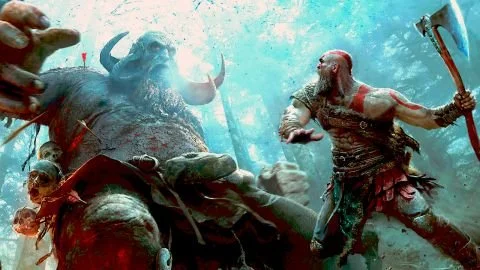
An incredible example of what is possible is the God of War produced by Santa Monica Studio for the PlayStation 4 series. Based loosely on Greek and Norse mythology, you become a God doing battle with other Gods. Along the journey, the player will encounter monsters of all sorts.

God of War


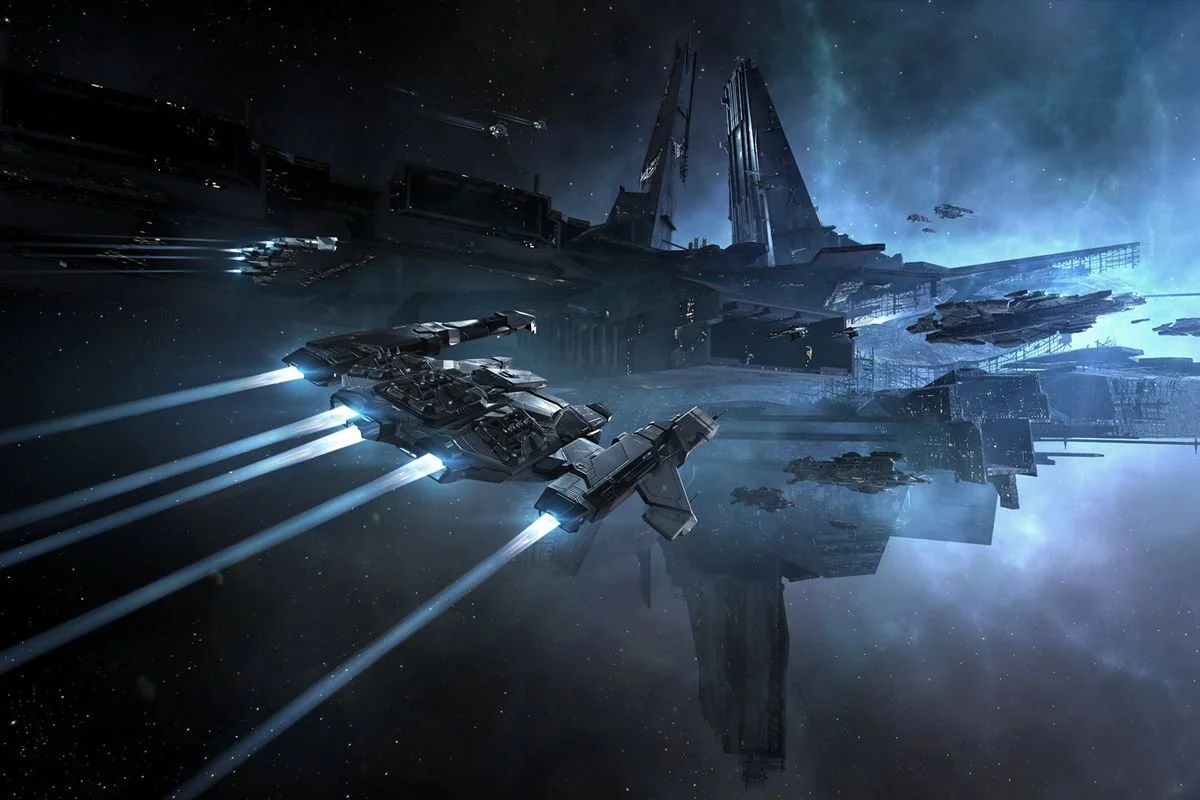
Another example is the game Galactic Civilizations produced by Stardock for Microsoft Windows. In this game the player gets to explore the planets and beyond using your own spacecraft, encountering other species. Another amazing example is Eve Online, produced by CCP Games. It has a scale and complexity that boggles the mind, as players compete and engage in large scale space warfare. The game takes the player right out into the Milky Way 21,000 years into the future. We have come a long way since board games like Monopoly and Dungeons and Dragons.

Eve Online

These sorts of games allow one to invent any species that we wish to, and then to enter those worlds and experience it like they really did exist. Only subtle errors in the simulation, a result of the currently limited technological capability of what we can program, visualise and trick our sensors over, give you a reminder that this really is just a game.

But what about the future? If the level of gaming is where it is today, where will it be in 10 years or 100 years or even 1,000 years from now. It seems quite possible that in the distant future, we will have the technological ability to create all of the fantasies of our best hopes and dreams but also of our worst nightmares. As we then continue to converge towards that technological-biological symbiosis it may even be possible that we could get hurt.

One of the things that is intriguing about our own mythologies is that although we tell our children certain things exist, we know as adults that we are really just telling stories. That is, about wizards, dwarfs, elves, giants, dragons, fairies or whatever it is our minds can conjure. Yet with this increasing convergence, and ultimately what will be an inability to tell the difference between the real world and the simulated world, everything that is in our children’s stories will come into existence. What are the implications of this? Are we heading ourselves towards a cliff-edge unable to stop the magnetic pull of technology upon us? And as we fully immerse ourselves in this world what does it imply for free will? Indeed, if our actual existing reality is just a simulation, are we really players in the game or constructs generated by a meta-mind for the benefit of players far in excess of our intelligence?

The science and science fiction writer Arthur C Clarke said that “Any sufficiently advanced technology is indistinguishable from magic”. Our universe and our very existence appear to be a miracle of nature. But is it really just the physical embodiment of someone else’s technology? And for the purposes of our existence, would it really matter?

This article was originally posted on a previous web site for the asterism project on 17th Sept 2019 and it has been copied here since that site was closed down.

Linquistics

One of the complex decisions to make about the Apkallu initiative artefact is what is the nature of the information that is to be displayed. It is useful to briefly explore different types of information.

The first written language was cuneiform and it was invented by the Sumerians in the late 4th millennium B.C. It is known as a language isolate since it does not have any genealogical relationship to other languages. The language began as a pictogram based system and then evolved to a logophonetic one. What is the difference?

A language based upon pictograms is one which conveys its meaning through an image to represent an physical object. Other than the original cuneiform the other good example of this is Egyptian hieroglyphic writing. Such things were also ideograms which represented symbols and ideas, and can often be independent of any particular language. Pictograms may often evolve into full logograms, which is a written character that represents a word of phrase.

The other type of writing is phonograms which do not have a word or phrase meaning in singular form until they are combined with other phonograms. This is the basis of phonetic writing and alphabets.

Fundamental to an alphabet is the concept of a syllable, which is a unit of organization for sounds of spoken word. A word that contains only one syllable is called monosyllable. For a word containing two, three or more syllables they are termed disyllable, trisyllable and polysyllable respectively. What makes up a syllable is a group of consonants and vowels. For the English language the vowels are a, e, I, o and u. All other letters are the consonants. 

A syllable is constructed around a central vowel which is called the nucleus. The consonant to the right of it is called the Coda, and with the nucleus this makes up what is called the Rime. If a consonant precedes the nucleus it is called the Onset

Here is an example to break this down. Let us take the word water. This contains two syllables, which are wa and ter. For the first syllable it contains only an onset and a nucleus. For the second syllable it contains an onset, a nucleus and a Coda and so also a Rime. 

What this all illustrates is that the structure of language is complex and this needs to be kept in mind in the design of the Apkallu initiative artefact. If logograms are used then careful thought must go into their choice. If phonograms are used then no matter what language they are written in, it has to be communicated to the future explorer who finds the artefact how a syllable and its constituents is the fundamental building blocks of language. 

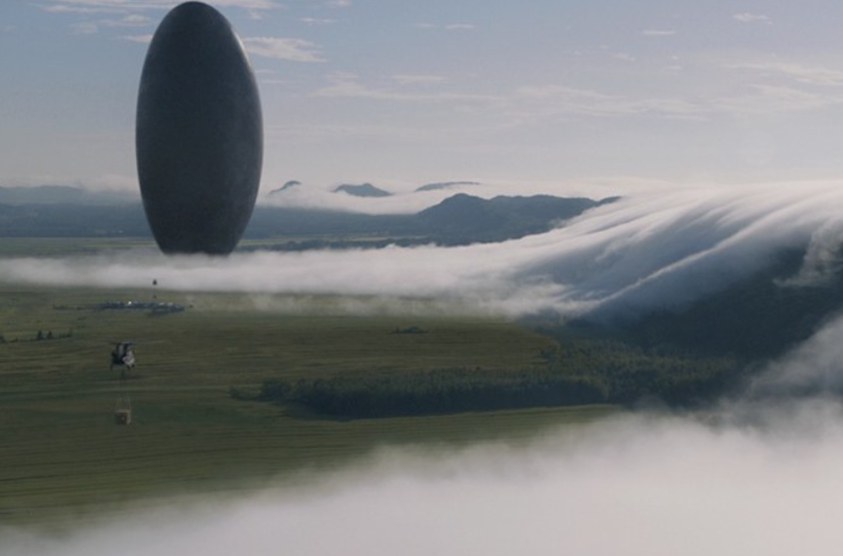
 In 2016 a film came out called 'Arrival', directed by Dennis Villeneuve and based on the short story by Ted Chiang called 'Story of Your Life'. One of the central events of the film is in an attempt to translate an unknown alien language, the word 'tool' is misunderstood to be 'weapon', leading to the pending tension that follows in the plot and the risk of a first contact scenario going horribly wrong. 

In the design of the Apkallu initiative artefact, one must also think carefully as to how any information encoded onto it can be misinterpreted. Indeed, on the assumption that the artefact was studied and embraced for all of the knowledge it could teach, there is even a risk that the artefact would start to be treated as a spiritual / religious item and so its text could be embraced by some as a form of dogma. This may in fact act to regress sociological and technological progress down the line, which is the opposite of what the Apkallu initiative wants to achieve.

For the Apkallu initiative, a full understanding of linguistic information transfer, is critical to the successful achievement of its mission.

This article was originally posted on a previous web site for the Apkallu Initiative on 3rd July 2018 and it has been copied here since that site was closed down.

IMAGINING THE FUTURE

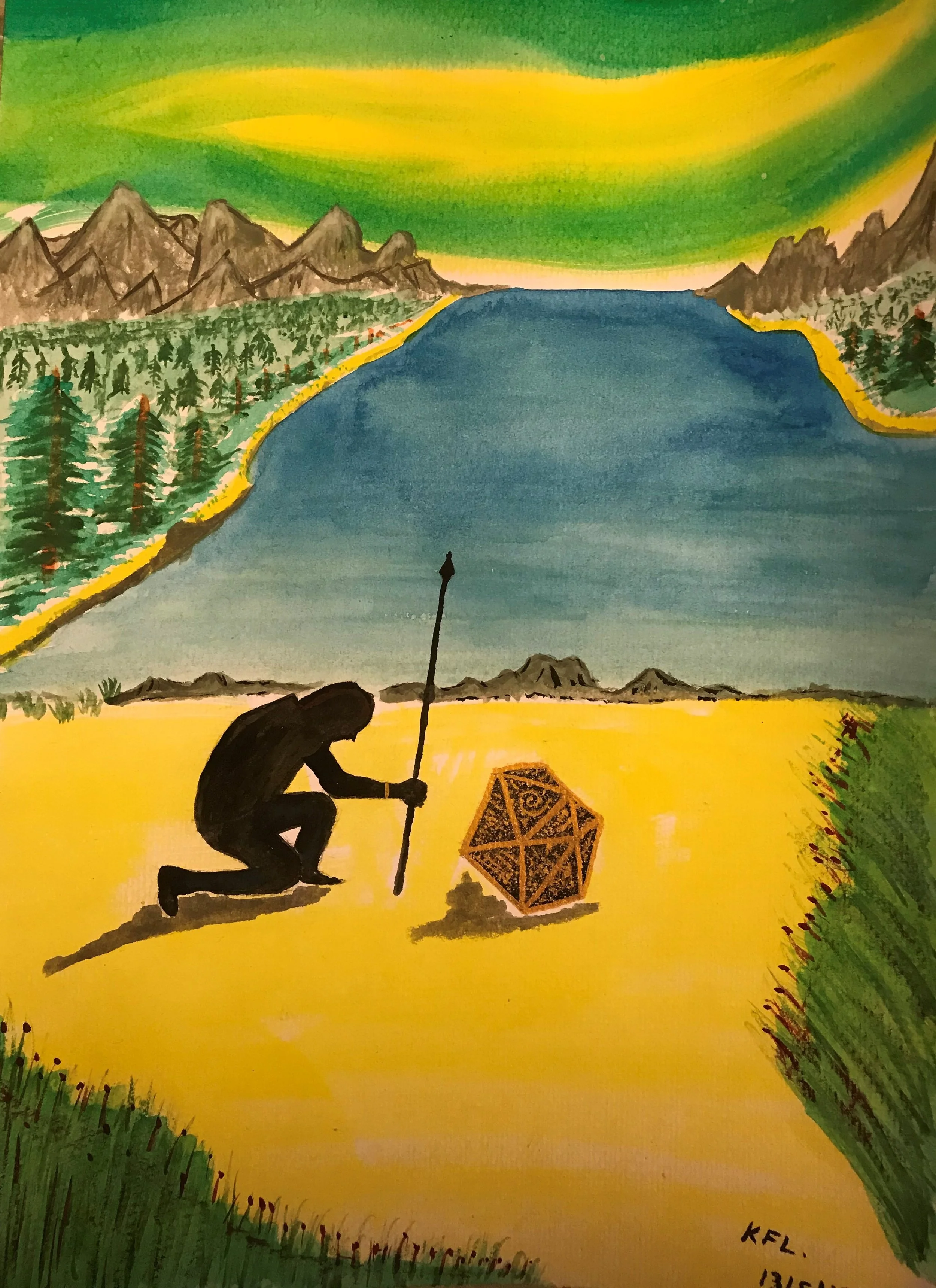
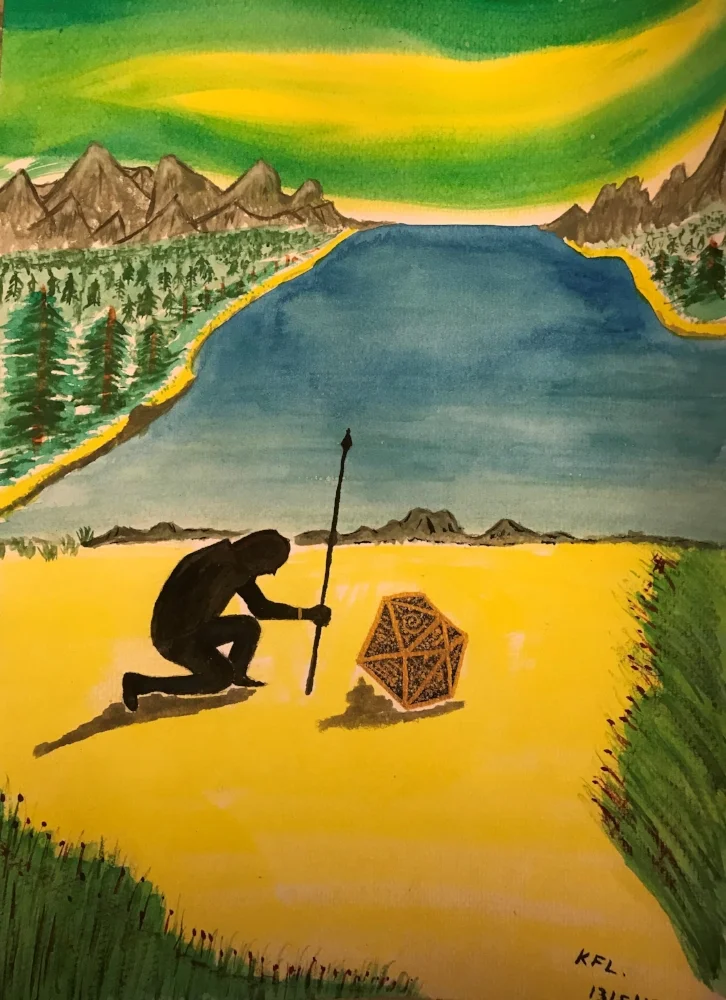
In the future, and in the event of some global cataclysm, we can imagine that some human would be wondering in the wilderness. They would be a survivor from a pocket community, exploring the landscape that remained and was in the process of renewing itself. Such a human, would be concerned with day to day survival, but also thinking about how they could rebuild the human future, so that we could once again move from a hunter-gatherer to an agricultural-farming community, where free time was available to study nature, science and the world at large and learn how to build a better civilized society. The painting below, imagines such a scene, where the Apkallu artefact is found on a remote beach, and its engraved knowledge looked upon with curiosity and awe.

Watercolour painting by K. F. Long

This article was originally posted on a previous web site for the Apkallu Initiative on 21st June 2018 and it has been copied here since that site was closed down.

INTERGLACIAL PERIODS IN HISTORY

During the history of Earth there have been five major ice ages, and we are currently in the Quaternary Ice Age at this time, which spans from 2.59 million years ago. Within the ice ages are sub-periods known as glacial and interglacial periods.

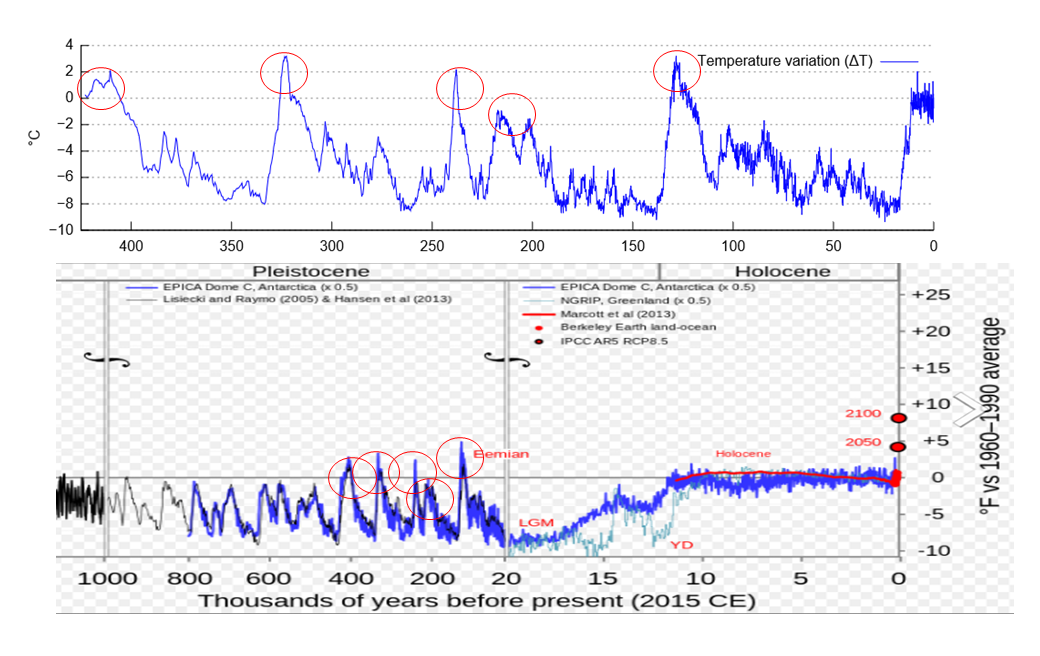
Recent measurements of the relative Oxygen isotope ratio in Antarctica and Greenland show the periods of glacial and interglacial periods throughout history over the last few hundred thousand years. This is a measurement of the ratio of the abundance of Oxygen with atomic mass 18 to the abundance of Oxygen with atomic mass 16 present in ice core samples, 18^O/16^O, where 16^O is the most abundant of the naturally occurring isotopes. Ocean water is mostly comprised of H^2-16^O, in addition to smaller amounts of HD-16^O and H^2-18^O. The Oxygen isotope ratio is a measure of the degree to which precipitation due to water vapour condensation during warm to cold air transition, removes H^2-18^O to leave more H^2-16^O rich water vapour. This distillation process leads to any precipitation to have a lower 18^O/16^O ratio during temperature drops. This therefore provides a reliable record of ancient water temperature changes in glacial ice cores, where temperatures much cooler than present corresponds to a period of glaciation and where temperatures much warmer than today represents an interglacial period. The Oxygen isotope ratios are therefore used as a proxy for temperature changes by climate scientists.

The Vienna Standard Mean Ocean Water (SSMOW) has a ratio of 18^O/16^O = 2005.2×10-6, so any changes in ice core samples will be relative to this number. The quantity that is being measured, δ^18O, is a relative ratio and is calculated as follows in the units of % parts per thousand or per mil.

The change in the oxygen ratio is then attributed to changes in temperature alone, assuming that the effects of salinity and ice volume are negligible. An increase of around 0.22% is then defined to be equivalent to a cooing of 1˚C given by 

T = 16.5 - 4.3(delta) + 0.14(delta)^2

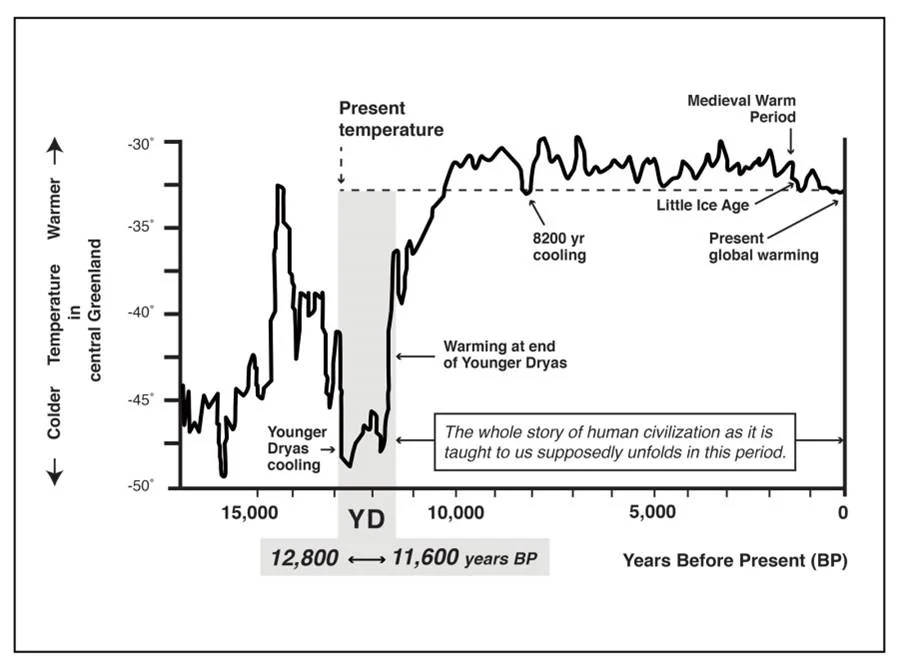
There are differences in the value of δ between the different ocean temperatures where any moisture had evaporated at the final place of precipitation. As a result the value has to be calibrated such that there are differences between say Greenland and Antarctica. This does result in some differences in the proxy temperature data based on ice core analysis, and Greenland seems to stand out, such as indicating a more dramatic Younger Dryas period (11,600 – 12,900) than other data.

An analysis of this data shows that the climate has varied cyclically throughout its history and is manifest of natural climate change. In particular what emerge out of the data are some interesting lessons about the recent history of planet Earth. Data shows the rapid oscillations of the climate temperature from the average temperature of today, indicative of glacial and interglacial periods. In particular, the data shows that during the Holocene period, beginning approximately 11,700 years before present, the temperature varied between 2-4 ˚C.

It is reasonable to assume that human civilisations under development will do better when the climate is kinder. This means that the warmer it is the better civilisations will do, and the colder it is, the harder the struggles. In particular we can expect that during the conditions of a colder climate that agricultural farming will suffer, and so there will be less food to go around, which will affect both life span and population expansion. To support this it is worth noting that the current epoch, the last 10,000 years has been the longest interglacial period for at least the last quarter of a million years and it is reasonable to therefore assume that this is one of the factors which has allowed human development from the emergence of the Neolithic period coming out of the last ice age.

Temperature proxy data from Greenland ice core samples of Oxygen isotope ratios.

The data also shows that there was a large global warming period known as the Eemian around 115,000 – 130,000 years ago. The average global temperatures were around 22 – 24 ˚C, compared to today where the average is around 14 ˚C. Forests grew as far north as the Arctic circle at 71˚ latitude and North Cape in Norway Oulu in Finland. For comparison North Cape today is now a tundra, where the physical growth of plants is limited to the low temperatures and small growing seasons. Given that Homo sapiens may have been here since around 300,000 years ago, this seems like a major opportunity for the development of human society from a people of hunter gatherers to one of agricultural developers and the development of a civil society.

There have been other interglacial periods that have resulted in global temperatures being either equivalent or above the average today, and the data shows temperature spikes of periods at around 200,000 years, 220,000 years, 240,000 years, 330,000 years and 410,000 years. Each of these interglacial periods will typically last at least 10,000 years.

Is it possible that these earlier periods in history allowed the opportunity for civilization to rise up and become sociologically and technologically advanced towards similar levels of today? The climate certainly seems to have allowed for it. The question is, did it happen?

This article was originally posted on a previous web site for the Apkallu Initiative on 2nd July 2018 and it has been copied here since that site was closed down.